My First Review and What We Can Learn About Our Kids


Recently, I self-published my first book. It is a picture book called Wandlung, and is itself unique in that it is the only idea I have ever had for a picture book. I am writing mostly short stories (some found on this blog under “Fiction“), children’s chapter books, and a fantasy/mythology epic. Wandlung is also unique because it is the only thing I have published this far (using the word “published” generously considering I published it myself with the help of my wonderful Kickstarter supporters!).

Yesterday Jen at WhatMyKidsRead.com did the first review of the book and I couldn’t be more pleased with her critique! Her family’s reviews are really helpful if you’re looking for books for a variety of ages as all of her kids provide their own input along with her perspectives on each title. For Wandlung, she gives a more detailed synopses of the story than I have yet done and goes into each of her family member’s thoughts about the story and illustrations. There is even a video review with Liam, the articulate eldest!

Part of Jen’s review that I really appreciated was something I am expecting to hear often. She reports that her kids liked the story a lot more than she did. She doesn’t prefer the premises upon which the story is founded and the story ending. Jen has wonderful taste in books, so if I wasn’t expecting many adults to respond this way I might have been devastated. But I’m glad about it, because I think out-of-the-ordinary picture books like this one actually teach us something about our children.

I may have said it before, but I’m a bit of a subversive at heart and a large part of what drew me to this story was the fact that the plot is probably more challenging to adults than to children. Wandlung challenges a lot of our modern preconceptions about stories that are good for children.

Kids have a knack for grasping concepts we don’t give them credit for understanding (which can be a good or bad thing in different circumstances) and they can often hear of a hardship befalling a character without flinching. Kids do not require a happy ending. What’s more, I believe that they should continue to cultivate this attitude toward stories and toward life. We learn to be disappointed when we refuse to accept anything other than our preconceptions of a “happy ending.” Kids start out with far fewer expectations than adults.

Anyway, I hope you will take the opportunity to check out the back story posted on the Wandlung page as well as the story itself. I am a much harsher critic of my own mind and I continue to think that this one warrants merit. If you think I’m crazy, please let me know!

55 Classics Review #2 – “The Man Who Was Thursday” by G.K. Chesterton


I get a little disappointed when I think about G.K. Chesterton.

I’m disappointed because the man was a force of sheer genius in almost every approach to the written word. Sadly, he is remembered for a very small portion of his prolific work, and what’s worse is he is often thought of simply as some guy who inspired some other guys people still really like. I do not intend to demean his most reputed works, but to reveal him as a far more expansive and influential catalist in British literature. Lets take a look at what some other people had to say about him.

Chesterton was “a man of colossal genius.” – George Bernard Shaw

“I cannot think of a single comic poem by Chesterton that is not a triumphant success.”

and

“When he is really enthrall we with a subject he is brilliant, without any doubt one of the finest aphorists in English Literature.” – W. H. Auden

“There is no better critic of Dickens living than Chesterton.” – T. S. Eliot

“[Chesterton] had a genius simply for having original ideas. . . It is hardly possible to read a page of Chesterton without finding an unexpected idea, at best wise, at worst fiendishly ingenious” – Wilfred Sheed, concerning the author’s essays.

“He was spontaneously witty, but he could also be carefully epigrammatic. He thought of words not as neutral rational counters, but as confetti, bonbons, artillery.” -Anthony Burgess

“The man is exuberant, so disrespectful to the learned, so deadsure, so comic where most serious.” – Maisie Ward

“Chesterton was a brilliant philosophical journalist. . .The range of talent was almost alarming. . .[He] was simply what the word ‘genius’ meant” – Wilfrid Sheed

But I’m afraid I’ve lost the plot. Back to the book.

All of these great statements about Chesterton do serve well to help illustrate the qualities found in The Man Who Was Thursday. While the book is less than 200 pages long, it is by no means a light read. It is dense with constant wit and aphorisms and is, according to the author’s subtitle, a nightmare. It is an extremely dense nightmare.

The book can best be split into three sections. Like a dream, however, the fluidity with which these segments flow together makes it impossible to recognize where the transitions take place until after they have happened. The book starts out as a very logical, philosophical and political debate between a poet of chaos/anarchy/nihilism and a poet of order/law/God. This is set within the realm of artistic community and at the pace of a detective novel. Things are reassuringly lucid at this point. The story becomes somewhat comic in sequence from the get-go, then at some point near the middle of the novel the reader pauses, looks wonderingly at the large portion of completed text in his left hand, and wonders when the story changed so drastically into a bizarre, Kafka nightmare. Everything has gone from a jaunty, shocking little narrative to to a heavy and incomprehensible nightmare world. Just as the reader begins to mentally threaten to drop the book for sheer emotional exhaustion, the story turn more whimsical and philosophically complex that ever before and suddenly all of the original questions of politicking and law-and-order are turned on their heads to be the real questions at the center of both the universe and ever individual’s struggle against it. In the end, questions are compounded and ideas of answers are hinted at, then all is left behind like a bad (or wonderful) dream.

Throughout all this the novel is decidedly Chesterton as described further above. The more serious the subject matter at hand, the more whimsical his writing. He has all the witty epigrammatic skills attributed to the Benjamin Franklins and the Winston Churchills of the world. He seems always to be poking fun at everyone, so that his opponent may be made the more furious even as he mocks his own inconsistencies. His main character Syme is distinctly like he himself as the narrator. While the other characters may be optimists or pessimists or anarchists or madmen, both narrator and protagonist take a light and poetic view that seems always to look at the bigger picture and remain almost in the third person for their seeming lack of personal pride at their own conclusions.

The book, among other Chesterton, has been compared to Kafka. He himself has even been called the anti-Kafka. Kafka read The Man Who Was Thursday and remarked “He is so gay, one might almost believe he has found God.” This is a great insight, because Kafka and Chesterton view the world from much the same standing, coming to drastically differing conclusions. Both men view the universe as a terrible and isolating empty space full to the brim with suffocating questions, yet their opposite tones display a response that could not be more drastically different. Kafka refused to be comforted or to believe in community. His comfort is in being honest about the horrors he feels, even in embracing them. The Man Who Was Thursday shows us clearly that Chesterton believed that isolation is an illusion and the source of a large majority of our unfounded fears. His characters are always realizing, comically, that their assumed enemies are actually their disguised advocates. The Man Who Was Thursday is in no way Chesterton’s attempt to simplify or resolve the complications of the unanswered overflow, but it is a reassurance that we can remain joyfully human and rest in faith.

For Fans Of: The Castle by Franz Kafka, That Hideous Strength by C.S. Lewis, The Stranger by Albert Camus

“What is your favorite ‘classic’ literary period and why?”


Over at The Classic’s Club they like to publish a “Monthly Meme”, a monthly blogging prompt question for the member to participate in. This months question is

“What is your favorite ‘classic’ literary period and why?”

I’ll provide my answer and ask you guys to feel free to do the same!

If you’ve been reading this blog then you know that I like to play fast and loose with terms like “classic”. Maurice Sendak is classic, Orson Scott Card is classic, Neil Gaiman is classic. In the same way I’m gonna bend the rules in defining my idea of a “literary period” as well. I ask for immense grace on the part of the reader.

I’m not really a fan of any one particular genre or period in which great work has been done; my tastes span just about every style from every time period. However, if I had to choose one time period as being great for the arts, I would choose 1914 to 1945. That is to say, the time frame from the beginning of The Great War to the end of World War II.

It is a hard truth to swallow, but war encourages good art. War encouraged better politics, better philosophy, better religion, and better culture. Are these worth the price? They probably never could be, but for some reason we need war to sharpen our ideas into feasible, real-world scenarios. I use the word “need” here not as an absolute belief but based on cyclical, historic evidence.

War takes the extreme ideals of young men and forces upon them (and everyone else) the costs and consequences of those ideas. Throughout history cultures have come to radical political and philosophical conclusions and have seen them tested in action through various political upheavals. A world-wide war has the unique sobering effect of drastically changing and solidifying the most earnest opinions at the very heart of every man. The World Wars and the time between them were an era of intense and costly trial and error, a time when every man and women, whether identified now as aggressor, defender, or victim, was drastically solidified in a frame of mind that would haunt or direct the remainder of his or her earthly experience. Grandiose philosophical and political ideals would eventually be pulverized into crippling fear, stunning bravery, blinding hatred, and inspiring forgiveness and understanding. All of the destruction wreaked resulted very clearly in artistic revolutions of all kinds.

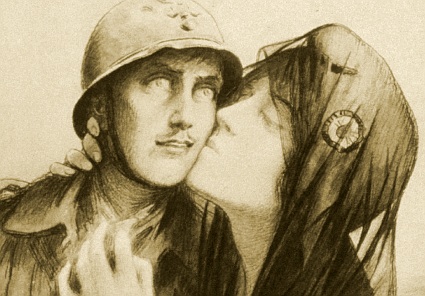
Concerning World War I, I think literarally of D.H. Lawrence, W. Somerset Maugham, Fitzgerald, Hemmingway, and T.S. Eliot among dozens of others. These are not necessarily known for war literature, but war imposed itself upon and transformed all in their craft. I consider C.S. Lewis and J.R.R Tolkien, destined to be friends as both fought through some of the most bloody and unsurvivable experiences of The Great War. Both lost most of their dearest friends, and even their more whimsical works are depicted with the sobriety of a man who has wrestled with war first-hand.

I consider the upheaved, unsettled time between the wars and the seemingly unavoidable onset of the Second World War. Another generation of men and women are rocked to their very cores, including Lee, Capote, Salinger, Vonnegut, Wouk, Mailer, and Lois Lowry among an entire generation in transition. Most rebelled against society at large, unable to cope with the unforeseen impacts that continue to ripple through culture today.

I especially think of the story of Ernest Hemmingway, already a revered author and now a war correspondent, meeting for drinks with a then-undiscovered J.D. Salinger, in a little house near the frontline in the midst of WWII. Young Salinger had carried a rough draft of the first six chapters of what would become The Catcher In The Rye stuffed in his jacket since before he landed on the beaches on D-Day and he had somehow found time to write and submit short stories to magazines from on the frontline. He had already built up a bit of a reputation with Hemmingway, and they spent a hearty evening together, drinking wine through the cold winter night and discussing the quality of Salinger’s work and literature in general. Before dawn they separated once more, and from what we know had very little interaction thereafter. Eventually, the elder would turn into a severe alcoholic before committing suicide, while the younger would seek solace in mystic religion and half a century of extreme reclusion.

While it can feel trite to explore the literary implications of the most destructive periods in world history, our art has more to say than anything else when we look to see how the minds of men are molded by these terrors. The lives of these artists, perhaps more so than their art at times, display the coping of humanity with unspeakable confusion. Some we find doubly moored to the foundations they already claimed, other finding some source of respite in the aftermath. So many others we find spiraling without answer, creating in the constant wake of the thousand-yard stare.

Wendell Berry’s Greatest Poem


While I have mentioned him here in passing, I must now go on record stating that Wendell Berry is my favorite living sage thinker. He takes the practical steps to live exactly what he believes. His life is an inspiration in its thought-out-and-acted-upon simplicity. He is a Kentucky farm boy, turned scholar and poet, turned university professor, turned cultural and political activist, turned farmer. While I would highly encourage you to dive into his essays, poetry, open letters, and novels, I am more eager that you delve deeper into his personal story.

While I would still consider myself a novice in his work, I always come back to one poem in particular. I have read and loved some of his short stories and his novel Hannah Coulter, and Jayber Crow is on my 55 Classic’s List. I have read many of his open letters and essays, and Bring It To The Table has also made its way into the 55.

Even with all this great material, I am most impressed by his poem “How To Be a Poet”.

How To Be a Poet
BY WENDELL BERRY
(to remind myself)

i

Make a place to sit down.
Sit down. Be quiet.
You must depend upon
affection, reading, knowledge,
skill—more of each
than you have—inspiration,
work, growing older, patience,
for patience joins time
to eternity. Any readers
who like your poems,
doubt their judgment.

ii

Breathe with unconditional breath
the unconditioned air.
Shun electric wire.
Communicate slowly. Live
a three-dimensioned life;
stay away from screens.
Stay away from anything
that obscures the place it is in.
There are no unsacred places;
there are only sacred places
and desecrated places.

iii

Accept what comes from silence.
Make the best you can of it.
Of the little words that come
out of the silence, like prayers
prayed back to the one who prays,
make a poem that does not disturb
the silence from which it came.

Is Life A Narrative And Does It Matter?


Last night I read a new article on a great blog I follow called The Bully Pulpit. The blog is mainly philosophical in bent with large doses of political thought and heaps of great quotes from thinkers throughout the ages. If you enjoy the Author Quotes section here you would probably like The Bully Pulpit.

I really find just about everything ol’ J.R. says over there to be fascinating and last night’s post didn’t disappoint. The post is titled “Is A Human Life A Narrative?” and it basically quotes a couple of authors on their thoroughly-devised philosophies of how life is distinctly not a narrative. They point out that life is simply a collection of random events to which human beings naturally assign a plot. J.R. seemed to readily agree with their logic.

The post has stirred up a lot of contemplation in me and I can tell it gets to others as well in an almost surprising way. Even though most people don’t frequently consider their own narrative or effective story-processing skills, it can prove quite unnerving to contemplate one’s own world as invalid or, worse, an illusion. As this simple blog can attest, I have made myself a student of story and creative inspiration. I have devoted a great deal to these concepts and even read some good books on the science behind the natural human behavior of narrative-based risk-weighing and decision-making (I highly suggest Wired For Story if you are a writer. While it is not a science text, it is a very light read on narrative design that builds upon scientific research into how we process information.) I would not say, however, that I have given an adequate amount of significant thought to the question of whether life is actually in fact a story. It seems that most of us interested in recognizing this axiom are already determined to validate and love on it.

I think it is easy for anyone to agree that, yes, the tuna sandwich I ate for lunch last Tuesday plays little to no role in my preconceived life narrative. While every little experience may be a grain of sand upon a scale which changes our attitudes over time, we would not include 90% of the actual content of our lives in a memoir. The things we do recognize as valuable are usually pivotal because they are sensationalized in our memories and because they are a cumulative representation, a turning point of events we would recognize as changing chapters or entire narratives from before and after said key memory. Regardless of these facts, the much larger and less theoretical question immediately becomes “should human beings continue to process information as narrative and do we even have a choice?”

I personally would argue that we have no choice in the narrative framework and that this is really a very good thing. Narrative is important. It gives life meaning. While “meaning” is a highly subjective concept, I still find it very hard to even conceptualize any sense of purpose outside of a larger set of implications termed as a narrative. It is also the starting point for processing concepts like relationship, responsibility, time, and cause-and-effect. Narrative as a cognitive tool is not invalidated by that fact that every detail of a life may not be an aspect of a consecutive narrative or by the fact that we cannot adequately process it. Many people use their narratives to successfully navigate life decision making, while many are deluded to make horrify decisions. It is not the narrative process that is at fault, it is the narratives themselves which are prone to great flaws.

This question on our minds also leads into a spider’s web of intricately related and equally daunting questions of fate, time and space, creative inspiration, and relationships.

If narrative-based cognitive processing is invalid, what are we to make of the repeated interactions between beings and/or objects?
Can we measure relationships in the scientific process without believing that we have a starting relationship, an added variable relationship, and an alter resulting relationship?
Can two human beings develop beyond strangers without a joint narrative?
Can we build an idea upon one formerly supposed without calling it a narrative?
How can you read and follow the (supposed) logic I’ve put forth in this article if not by some form of following a narrative?

So many good questions included here, I would love to hear your thoughts, further questions, and rebuttals!

55 Classics Review # 1 – “In The Night Kitchen” by Maurice Sendak


“In The Night Kitchen” is one of the most unusual books I chose to include in my 55 Classics. It is unusual because I’ve nearly memorized it I’ve read it so many times and it’s unusual because it is just a picture book.

If people know Maurice Sendak’s name, they usually associate it with Where The Wild Things Are. While I also love that book, I have reasons to prefer Night Kitchen.

ITNK is part comic strip part children’s story, part nostalgia and part bizarre dreamscape. The book follows Mickey as he falls out of bed one night and into the hands of “the bakers who bake till dawn,” experiencing and triumphing through a number of otherwise horrific adventures in a place called the night kitchen. In the end he jumps off of a huge bottle of milk and slides safely back into bed.

As someone who grew up addicted to newpaper comics, it is easy to see that Sendak finds huge quantities of inspiration for the style and imagery in old strips like Little Nemo. His three identical baker characters steal the identity of Oliver Hardy of Laurel & Hardy fame. Everything about this book’s aesthetic takes cue from the culture and advertisements of the 1920’s and 30’s. Sendak’s considerable illustration skills are put to good use in a totally unique setting of his own invention.

Bakers

The second and equally critical component to this book is its beautiful, lyrical text.
It does not attempt to rhyme. Sendak even seems to intentionally avoid obvious opportunities to create rhyming texts. I believe this is because rhyming would take away from the very nature of this nonsensical story. It does not rhyme, but it flows and sings beautifully. Anyone would have a very hard time not reading this book with a sort of musical quality. My 3 year old daughter has most of the text memorized, and I hold its sing-ability as a key to her latching on to so much of its text so proficiently.

Overall, I like Maurice Sendak’s work because he was an exceedingly talented illustrator who somehow retained the ability to think like a child. He stories don’t have to have strong plot lines or heavy-handed morals, but children have and always will love them.
Why?
Because he validates their dreams, those by day and by night.

The Classics Club


This morning I stumbled upon a wonderful blog called The Classics Club. Its exactly what I never knew I was searching for!

The premise of the club is a simple one. To join, one must simply submit a list of at least 50 titles that you personally consider classic in some way and commit to attempting to read and review all of them within a time frame of hire own choosing, up to five years. I eagerly spent some of my morning and afternoon building my own classics list.

A Few Notes Concerning My Selections

• I chose a very broad spectrum of titles because I am interested in a broad spectrum of fiction. I am aware that many, nay most, are probably not classics or only exist as classics in a certain subculture.

• They are in the order I came up with them, so I will not be reading them in this or any other particular order.

• I chose a number of children’s titles because I love children’s literature more now than when I was a kid.

• The spirit of the club is to read new titles, so I have only allowed myself step or three re-reads. I chose them mostly because they are lesser known titles and I was eager to re-read them to review them.

• Most of these are either titles I own and have not read or titles I started once and got side-tracked from finishing.  I thought this seemed like a great opportunity to officially pursue them more diligently.

• The list is mainly novels and chapter books, with a smattering of short story collections, picture books, essays, and curated diaries.

• I intend to use the maximum allotment of five years, finishing the list by 2/22/2019.

The List (55 titles)

– The Plague by Albert Camus

– The Phantom Tollbooth by Norton Juster

– Watership Downs by Richard Adams

– Letters To An American Lady by C.S. Lewis

– On Stories by C.S. Lewis

– The Worm of Ouroboros by E. R. Eddison

– The Giver by Lois Lowry

– Mr. Bliss by J.R.R. Tolkien

– Slaughterhouse Five by Kurt Vonnegut

– The Railway Children by E. Nesbit

_______

– Odd And The Frost Giants by Neil Gaiman

– Phantastes by George MacDonald

– The Jamaica Inn by Daphne Du Maurier

– The Silmarilion by J.R.R. Tolkien

– Jayber Crow by Wendell Berry

– Ender’s Game by Orson Scott Card

– A Room With A View by E. M. Forster

– Redwall by Brian Jacques

– Peter Pan by J. M. Barrie

– Poems of John Keats by John Keats

________

– Brothers and Friends : The Diaries of Major Warren Lewis by Warren Lewis

– The Third Man by Graham Greene

– The Thin Man by Dashiell Hammett

– The Murder Of Roger Ackroyd by Agatha Christie

– Peril At End House by Agatha Christie

– Bring It To The Table: On Farming And Food by Wendell Berry

– The Book Thief by Markus Zusak

– Descent Into Hell by Charles Williams

– War In Heaven by Charles Williams

– The Food Of The Gods And How It Came To Earth by H. G. Wells

_____________

– Chitty-Chitty Bang-Bang by Ian Fleming

– Mary Poppins by P. L. Travers

– The Graveyard Book by Neil Gaiman

– At The Back Of The North Wing by George MacDonald

– Jeeves In The Offering by P. G. Wodehouse

– Heavy Weather by P. G. Wodehouse

– Middlemarch by George Eliot

– The Narrative Of Arthur Gordon Pym Of Nantucket by Edgar Allan Poe

– Frankenstein by Mary Shelley

– The Razor’s Edge by W. Somerset Maugham

__________

– On Human Bondage by W. Somerset Maugham

– A Confederacy Of Dunces by John Kennedy Toole

– An Arsene Lupin Omnibus by Maurice LeBlanc

– The Man Who Was Thursday by G. K. Chesterton

– The Innocence of Father Brown by G. K. Chesterton

– King Solomon’s Mines by H. Rider Haggard

– The Sorrows Of Young Werther by Johann Wolfgang von Goethe

– Pygmalion by George Bernard Shaw

– In The Night Kitchen by Maurice Sendak

__________

– Runaway by Alice Munro

– The Thirty-Nine Steps by John Buchanan

– I Sing The Body Electric by Ray Bradbury

– Walden by Henry David Thoreau

– My First Summer In The Sierras by John Muir

_______

As a somewhat saddening side-note, I realized while curating this list that I finished reading every Sherlock Holmes novel years ago. While there are only four novel-length Holmes stories, I was surprised to realize that I had finished all of them years ago. I’m certain that I haven’t read all the short stories yet, but it was a strange sensation to realize that I had long since finished these and even forgotten that I had completed every one of them.

Anyway, I am excited to get any feedback as I start! If you have any personal thoughts, experiences, or opinions on any or all of these titles, I would love to hear them. I need all the advice I can get!

C.S. Lewis And J.R.R. Tolkien: “The Strength Of The Hills Is Not Ours”


While permaculture is still a newish (30-40 years) subject of suddenly increased interest (myself falling in among the band-waggon stagers), I’m learning not to be surprised when I stumble upon a highly relevant, pre-dating thought from someone who would not be considered a natural farming resource. In a letter to his life-long pen pal Arthur Greeves dated the 22nd of June, 1930, C.S. Lewis mentions Tolkien’s thoughts on the spiritual and generational effects of living directly off of the physically surrounding country.

“Tolkien once remarked to me that the feeling about home must have been quite different in the days when the family had fed on the produce of the same few miles of country for six generations, and that perhaps this was why they saw nymphs in the fountains and dryads in the wood – they were not mistaken for there was in a sense a real (not metaphorical) connection between them and the countryside. What had been earth and air & later corn, and later still bread, really was in them. We of course who live on a standardised international diet (you may have had Canadian flour, English meat, Scotch oatmeal, African oranges, & Australian wine to day) are really artificial beings and have no connection (save in sentiment) with any place on earth. We are synthetic men, uprooted. The strength of the hills is not ours.”

People like Fukuoka, Lewis, Berry and Tolkien seem to have this in common: they interest was not in resonse to a couple of generations of problems and discontent, or because of some impending global disaster. They began by asking themselves much larger questions about what it means to be human and, when alighting upon confident conclusions, the implications of what they understood led them to value the concepts that permaculture and natural farming ideals now come to out of desparation or fear. They were asking these questions in the 1920’s, 30’s, and 50’s. When everyone else was head over heels in love with new technologies, they were wondering at what had been lost. I am in no way implying that those who desire to live naturally do not see the immense beauty before them, I only mean to point out the difference between coming from a concept to its implication versus finding that the natural is the necessary solution to so much unnatural action. I think I’ll go medetate on these philosophies a bit more before heading back into the practical how-to’s.

Author Quotes: Mark Twain, Alcohol, and Amusement


Here is another absolute gem I came upon in Mason Curry’s Daily Rituals.  This time it is none other than Mark Twain being described by a personal friend.  

“In those days he was troubled with sleeplessness, or, rather, with reluctant sleepiness, and he had various specifics for promoting it. At first it had been champagne just before going to bed, and we provided that, but later he appeared from Boston with four bottles of lager-beer under his arms; lager-beer, he said now, was the only thing to make you go to sleep, and we provided that. Still later, on a visit I paid him at Hartford, I learned that hot Scotch was the only soporific worth considering, and Scotch whiskey duly found its place on our sideboard. One day, very long afterward, I asked him if he were still taking hot Scotch to make him sleep. He said he was not taking anything. For a while he had found going to bed on the bath-room floor a soporific; then one night he went to rest in his own bed at ten o’clock, and he had gone promptly to sleep without anything. He had done the like with the like effect ever since. Of course, it amused him; there were few experiences of life, grave or gay, which did not amuse him, even when they wronged him.”
*Bold emphasis mine.  

This little anecdote seems to summarize the popularity of Samuel Clemens’ work and a good many of his famous thoughts quite well. There is something very comforting and reassuring about an author (or any human) who is capable of sharp cultural and personal analysis while maintaining a good-humor. We trust people who are well aware of the travesties of humanity in general and their own brokenness while maintaining hopefulness and engaging others. We know the truth, we recognize it together, and we keep renewing our faith.

Author Quotes – Ingmar Bergman, Worship, and Artistic Motovation


I love Hitchcock, Wes Anderson, Truffaut and Rod Serling. I have a handful of shining favorite film makers who stand far above the rest, and they are all very different from one another. One of the newer (to me) yet most deeply moving of the whole bunch is Ingmar Bergman. His film Wild Strawberries is the most deeply personally-revelatory film I have ever seen. It means a little more to me each time I consider it.

Bergman’s films have a common theme of fear facing the inevitability of death which stands at nervous odds with a perception that God is there but faith is not sufficient to bolster the soul’s confidence. His characters find death so overwhelming that they can find no solace in what they see as a less overwhelming faith. I read this quote from Four Screenplays Of Ingmar Bergman and found his perspective even more complex than his films make it appear.

“Regardless of my own beliefs and my own doubts, which are unimportant in this connection, it is my opinion that art lost its basic creative drive the moment it was separated from worship. It severed an umbilical cord and now lives its own sterile life, generating and degenerating itself. In former days the artist remained unknown and his work was to the glory of God. He lived and died without being more or less important than other artisans; ‘eternal values,’ ‘immortality’ and ‘masterpiece’ were terms not applicable in his case. The ability to create was a gift. In such a world flourished invulnerable assurance and natural humility. Today the individual has become the highest form and the greatest bane of artistic creation.
The smallest wound or pain of the ego is examined under a microscope as if it were of eternal importance. The artist considers his isolation, his subjectivity, his individualism almost holy. Thus we finally gather in one large pen, where we stand and bleat about our loneliness without listening to each other and without realizing that we are smothering each other to death. The individualists stare into each other’s eyes and yet deny the existence of each other.”

Even for a man so troubled by the idea of so much blind faith, art for no sake but the individual doesn’t click. It does seem quite a fair assessment to me.