Author Quotes

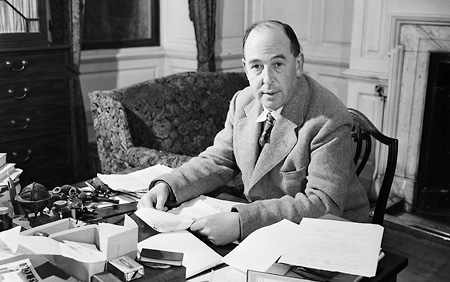
55 Classics Review #6 – On Stories And Other Essays On Literature by C.S. Lewis


When it comes to popular spiritual epigrams, C. S. Lewis has G.K. Chesterton, Martin Luther King, Ghandi, and maybe Jesus himself beat in terms of popular quotability. It seems impossible to browse any social media outlet without coming across a line from Narnia or The Screwtape Letters. That is what intrigues me the most about Lewis. A huge quanitity of the most enlightening statements he ever made came from the mouths of characters in fiction, rather than from any articles of non-fiction.

On Stories is therefore one of the greatest resources for getting behind this veil. In it we discover bits of the frame of mind capable of creating such original and timeless stories that seamlessly imply his deepest ideas about being human.

The book is a simple collection of essays, author dedications, op-ed pieces, and even a transcript of a conversation between Lewis, Kingsley Amis, and Brian Aldiss about the nature and value of science fiction as a genre. Many of the articles were never published, some merely scraps, unedited and unfinished.

On Stories cover a lot of ground, seeing Lewis address concepts and wrestle with idea which many of his popular quoters might find questionable or reproachable. He expresses interest in seeing good science fiction proposing a third gender, proposed that children’s literature shouldn’t shy away from being frightening, and emphatically endorses a lot of literature which some people might prefer to be banned. Overall, you are getting a much more rounded picture of the author’s ideas than you ever can from any piece or body of fiction.

The themes that come through most clearly are his strong opinions about fantasy and science fiction being absolutely valuable endeavors for both children and adults and his general rebuttals against the overwhelming academic ideas on literature from his day. He proves himself extremely well-read in everything from the classics (no surprise here as he was a world-class medievalist) to the science fiction paperbacks which were just gaining a huge foothold. He holds firmly that each has its own place of legitimate value to the reader.

One of my personal favorites was A Reply To Professor Haldane. A posthumously discovered response to the multiple, brutal assaults on his intellect by a professor of theoretical biology, this essay is at once precisely factual and sterile of any character assassinations. A discovered rough draft like this only highlights the immensity of logical preparation he puts into his ideas. He explains himself theoretically and through example while completely tearing down his opponent’s ideas without ridiculing the man. Indeed, it is easy to feel that Lewis has no emotional response to those who continually abused his character. Like Chesterton, one cannot help but admire his ability to let accusations roll off his back while taking the ideas involved quite seriously.

Overall, I highly suggest this title to any Lewis fan or general fan of science fiction and fantasy. If you’ve ever felt frustrated at those who don’t get why fairy tales or space travel stories are legitimate, you will find a friend in Lewis. I would also highly recommend this book if you’re interested in reading the more obscure works that have influenced modern fantasy, adventure, and sci-fi writing. Lewis is constantly referring to what he considered the classics of these genres.

Though you may not always agree with his conclusions on the issues he tackles, it is hard to fault the man for lack of thorough contemplation or sincerity in wrestling with all forms of literature.

_____________

I’ll leave you with this delightful transcribed dialogue between Lewis and Kingsley Amis, and Brian Aldiss.


“Lewis: Would you describe Abbott’s Flatland as science-fiction? There’s so little effort to bring it into any sensuous–well, you couldn’t do it, and it remains an intellectual theorem. Are you looking for an ashtray? Use the carpet.

Amis: I was looking for the Scotch, actually.

Lewis: Oh, yes, do, I beg your pardon. . .But probably the great work in science-fiction is still to come. Futile books about the next world came before Dante, Fanny Burney came before Jane Austen, Marlowe came before Shakespeare.

Amis: We’re getting the prolegomena.

Lewis: If only the modern highbrow critics could be induced to take it seriously. . .

Amis: Do you think they ever can?

Lewis: No, the whole present dynasty has got to die and rot before anything can be done at all.

Aldiss: Splendid!

Amis: What’s holding them up, do you think?

Lewis: Matthew Arnold made the horrible prophecy that literature would increasingly replace religion. It has, and it’s taken on all the features of bitter persecution, great intolerance, and traffic in relics.”


Related Reading

————

C.S. Lewis and Common Core Logic

C.S. Lewis On How Words Die

C.S. Lewis and J.R.R. Tolkien On Our Connection To The Land

Author Quotes: Wendell Berry On Paths And Roads


“The difference between a path and a road is not only the obvious one. A path is little more than a habit that comes with knowledge of a place. It is a sort of ritual of familiarity. As a form, it is a form of contact with a known landscape. It is not destructive. It is the perfect adaptation, through experience and familiarity, of movement to place; it obeys the natural contours; such obstacles as it meets it goes around. A road, on the other hand, even the most primitive road, embodies a resistance against the landscape. Its reason is not simply the necessity for movement, but haste. Its wish is to avoid contact with the landscape; it seeks so far as possible to go over the country, rather than through it; its aspiration, as we see clearly in the example of our modern freeways, is to be a bridge; its tendency is to translate place into space in order to traverse it with the least effort. It is destructive, seeking to remove or destroy all obstacles in its way. The primitive road advanced by the destruction of the forest; modern roads advance by the destruction of topography.

That first road from the site of New Castle to the mouth of the Kentucky River–lost now by obsolescence or metamorphosis–is now being crossed and to some extent replaced by its modern decendant known as I-71, and I have no wish to disturb the question of whether or not this road was needed. I only want to observe that it bears no relation whatever to the country it passes through. It is a pure abstraction, built to serve the two abstractions that are the poles of our national life: commerce and expensive pleasure. It was built, not according to the lay of the land, but according to a blueprint. Such homes and farmland and woodlands as happened to be in its way are now buried under it. A part of a hill near here that would have caused it to turn aside was simply cut down and disposed of as thoughtlessly as the pioneer road builders would have disposed of a tree. It’s form is the form of speed, dissatisfaction, and anxiety. It represents the ultimate in engineering sophistication, but the crudest possible valuation of life in this world. It is as adequate a symbol of our relation to our country now as that first road was of our relation to it in 1797.”

– Wendell Berry, excerpt from A Native Hill
____________

Berry’s words are potent, but they carry an extra weight for those have grown up on I-71 and can visualize its toll on the land. It’s true that the principle remains the same anywhere, but part of his point lies in relating to the land itself, and I can picture the very landscapes he has in mind.

A Native Hill is a wonderful and expansive essay covering Berry’s own flight from and eventual enlightened return to the Kentucky hillside his forefathers had long farmed.

Listen Awhile Ye Nations, And Be Dumb.


Great spirits now on earth are sojourning;
He of the cloud, the cataract, the lake,
Who on Helvellyn’s summit, wife awake,
Catches his freshness from Archangel’s wing:
He of the rose, the violet, the spring,
The social smile, the chain for Freedom’s sake:
And lo!–whose steadfastness would never take
A meaner sound than Raphael’s whispering.
And other spirits there are standing apart
Upon the forehead of the age to come;
These, these will give the world another heart,
And other pulses. Hear ye not the hum
Of mighty workings?–
Listen awhile ye nations, and be dumb.
________

– John Keats, Addressed To Haydon, 1816

I never got poetry. When I was in elementary school my younger brother and I collected a binder full of our own attempts at poetry, but the only goal was to write simple, silly verses that rhymed. Apart from thoroughly enjoying complex rhymes, I never understood the draw of poetry. Even in school I never understood the enjoyment of poetry and the basic concepts involved didn’t make me excited. I couldn’t force iambic pentameter to mean anything on paper and I was without a passionate poet, so it bored me thoroughly. I was never really sure what to make of free verse.

Now, a decade later, I’m starting to really think there might be something I missed in this poetry stuff. I mean, I always assumed it must truly interest many people, but I wasn’t one of them. After realizing that so many people I respect were either heavily fashioned by poetry or were poets themselves, I have become somewhat determined to invest myself in understanding its enjoyment.

The three things I’ve come to understand about poetry thus far are that it is best read slowly, aloud, and indulgently.

Perhaps what I mean is that, in my experience, poetry is only enjoyable when it is paired with a slow lifestyle. When I was a child I assumed it was simply about rhyming. In school I never understood how the more complicated terminology explained any enjoyment. Now I am starting to realize that the poetry itself lies in the audible flow of the words.

I’ve always greatly appreciated prose. A witty or profound sentence full of large or interesting words is sure to be a delight. Now I’m starting to realize that poetry carries a similar intoxicant which is meant for sipping. Poetry is for re-reading, for memorization even, both skills that seems to have mostly fallen out of vogue. Memorization for pleasure rather than duty.

I have started slowly with the mostly free verse of Wendell Berry. His wonderful prose requires slow reading, and the transition to his poetry is a smooth one. From there I have begun to dabble in Keats, and I hope to eventually build up an appetite for modern poetry like Elliot and the old epic poems like La Morte D’Arthur, Spenser, and Milton.

My goal in this busy world is to slow down, so I think poetry is all the more worthy a pursuit. Like Keats says, if we slow down enough to take it all in, perhaps we will be able to stay quiet for a bit.

If you love poetry, please tell me why, and by whom.

Author Quotes: Masanobu Fukuoka and The Philosophy Behind The Science


“Before researchers become researchers they should become philosophers. They should consider what the human goal is, what it is that humanity should create. . .

Modern research divides nature into tiny pieces and conducts tests that conform neither with natural law nor with practical experiences. The results are arranged for the convenience of research, not according to the needs of the farmer. To think that these conclusions can be put to use with invariable success in the farmer’s field is a big mistake.
Recently Professor Tsuno of Ehime University wrote a lengthy book on the relationship of plant metabolism to rice harvests. This professor often comes to my field, digs down a few feet to check the soil, brings students along to measure the angle of sunlight and shade and whatnot, and takes plant specimens back to the lab for analysis. I often ask him, ‘When you come back, are you going to try non-cultivation direct seeding?’ He laughingly answers, ‘No, I’ll leave the application to you. I’m going to stick to research!’
So that is how it is. You study the function of the plant’s metabolism and its ability to absorb nutrients from the soil, write a book, and get a doctorate in agricultural science. But do not ask if your theory of assimilation is going to be relevant to the yield.”

– Masanobu Fukuoka, from the essay “Limits of the Scientific Method” in “The One-Straw Revolution.” Translated from the original Japanese.
________

I have spoken briefly about Fukuoka here before, but the man really deserves a greater deal of credit for the things he revealed in his lifetime. A trained scientist and researcher himself, his contributions came not in any scientific field but through over half a century of rehabilitating fields and orchards that had been utterly sapped.

Fukuoka realized, simply, that when we live outside of the order and systems of nature, which replenishes its own resources, we are building a false reality. Based on this premise, he quit his scientific research and went to discern how to cultivate the land while altering nature as little as possible. He learned to do less alteration than any other form of farming while producing comparable or increased harvests. The only requirement was to spend a few years getting to know the land, weather, and the nature of the plants being propagated.

I usually read his work with my mouth hanging open. The man worked hard in his fields and orchards for around 70 years, devoting his old age to researching solutions to fight desertification. In his lifetime he perfected completely natural farming of all kinds of grains, vegetables, and citrus. Yet somehow, his work goes unnoticed by those who don’t seek it out.

Author Quotes: C.S. Lewis and Common Core Logic, Part II


“These well-meaning educationalists are quite right in thinking that literary appreciation is a delicate thing. What they do not seem to see is that for this very reason elementary examinations on literary subjects ought to confine themselves to just those dry and factual questions which are so often ridiculed. The questions were never supposed to test appreciation; the idea was to find out whether the boy had read his books. It was the reading, not the being examined, which was expected to do him good. And this, so far from being a defect in such examinations is just what renders them useful or even tolerable.

. . .What obsequious boys, if encouraged, will try to manufacture, and clever ones can ape, and shy ones will conceal, what dies at the touch of venality, is called to come forward and perform, to exhibit itself, at that very age when its timid, half-conscious stirrings can least endure such self-consciousness.”

– C.S. Lewis, excerpt from the Essay “The Parthenon And The Optative”

________

In Part I of my comparison between C.S. Lewis critique of 1940’s British educational reformers and the modern Common Core logic, I discussed the areas in which we would possibly disagree. Now I strike on the overarch philosophy on which I believe we agree.

Lewis was fighting against a beast which is mostly foreign to us today. While some of his ideas sound more in favor of something like a Common Core standard, I would argue that his underlying assumptions were totally opposed to it and his expressed ideal circumstances were a call for a middle ground between a logical foundation and a passionate pursuit.

We should start by noting the four cultural ideals involved in our conversation. They are Lewis educational ideals, the reforming ideas of the 1940’s, the current ideas of the Common Core reform, and my own perspective.

1. Lewis is old school. While he highly values the emotions involved in enjoying literature, he starts (in all things) with logical undergirdings. From true understand appreciation can grow. He says that even when a student dislikes the material, we have “at the very least, taught the boy what knowledge is like. He may decide that he doesn’t care for knowledge; but he knows he doesn’t care for it, and he knows he hasn’t got it.”

2. The period reformers were attempting to shift to test students on their capability to appreciate rather than comprehend the materials at hand, and to do so by judging them on localized standards with educator peer reviews. Their goal was to give educators the freedom to make attempts revealing what the Norwood Report called the “sensitive and elusive thing” in appreciating literature instead of testing the “coarse fringe” that is testing for detailed comprehension. “The teacher’s success can be gauged by himself or by one of his immediate colleagues who knows him well.”

Lewis stands against both educating for appreciation and in-house assessments. He believes that students would be more hindered by trying to sound appreciative of the works for test performance than they would be by having to evaluate the actual materials for answers. He also questions whether anyone can learn the materials for their own merit if the testing is based on the professor’s interpretations of the material rather than its content. You have to agree with the professor’s preferences to do well.

3. “The Common Core State Standards provide a consistent, clear understanding of what students are expected to learn, so teachers and parents know what they need to do to help them. The standards are designed to be robust and relevant to the real world, reflecting the knowledge and skills that our young people need for success in college and careers. With American students fully prepared for the future, our communities will be best positioned to compete successfully in the global economy.” If you read this mission statement the wrong way it might sound like nationalist propaganda. We will tell the teachers and parents what to say. The students will be proud to make their nation great.

Common Core is based on a couple of nearly-standard American cultural premises. The first I would describe as a fast food standardization. You can get the exact same Big Mac at any McDonalds across the globe, and our industrial society sees this as a golden rule for progress, including within our education system. Leave a 5th grade class in small town Connecticut on Monday, pick up where your left the standard text in a classroom in San Francisco on Tuesday. Everyone should learn the exact same things at the same age, and this is automatically good for them. To personalize the system is to devote too many resources.

The second problematic idea behind modern education theory is that simple, blue collar work is less valuable than jobs requiring higher level expertise. Obviously, from a monetary perspective, many positions requiring an education pay better, but often a trade school education or specialized machinist skills can pay just as well with much less irrelevant education involved. We live in a culture that looks down on less intellectually charming roles. We have outsourced our manufacturing because we believe that we have transcended the lowly skills involved in creating our own things. Most people used to spend their time growing food, but now the idea of farming tends to conjure up images from The Grapes Of Wrath.

Common Core functions based upon the faulty cultural presuppositions that everyone needs to know everything equally and that higher education is automatically valuable to everyone. It is partially spurred on by similar hopes to those of the old educators who wanted people to really be engaged by and in love with what they were learning, but it also refuses to believe that a basically educated and simply enjoyed life is actually valid. “Ignorance is bliss” becomes not simply an unwise axiom, but a moral heresy.

4. Lastly, I come to my own ideas. I do not wish to lay a claim as an authority on education. I have had a handful of very illuminating conversations with educators and educational theorists, but those don’t hold much weight. What I have had is the pleasure of knowing and truly enjoy a lot individuals of all passions and education levels; the opportunity to see so many diverse people learning to explore their own giftings and interests makes the idea of an extreme and mechanical standardization of education a dystopian prospect. Education should pour out of relationships. Relationship most importantly of student to materials, and secondary of student to instructor.
_________

All four perspectives hold in common, as some level, some authentic desire for people to learn and to utilize and enjoy what they learn. There is no contradiction in that aspect of their goals, it is in execution where the distinctions become radical.

The old reformers push for a common modernist idea of focusing on interpretation almost to the exclusion of the source material. Their desire is overtly to pursue interest and response over basic understanding. The Common Core logic takes this idea and requires it of everyone. Every student must be equally interested in and capable of all things. Not only can we enforce interest, but we can standardize it.

Here we finally come to the points on which to take Lewis very seriously. Lewis proposes that we simply give the students the most basic materials and make sure that they are comprehending what they are given, then allow them to determine their own interest level beyond that point of understanding.
Revolutionary.

Lewis’ perspective on educating is like throwing seeds of knowledge and waiting to see what sprouts up when they find ample mental sustenance. Who are we to force things to grow were they are not wanted or sustained? Everyone benefits from being able to multiply, but is geometry valuable to all? I believe that passionate teachers (something Lewis seems to assume regardless) who can foster their interests should be the second goal.

The truth is that we should become as comfortable as Lewis seems to be with relequishing control and allowing a student to shun what we hold sacred. If the son of two Master’s degree parents wants to be a farmer, who should hold him back from it? If the daughter of a poor miner wants to become a neurosurgeon, who can hold her back?

Our system has made some great headway in making education available to all via public libraries and public schooling. We should continue to pursue greater excellence in these. But the innate desire to learn is often too valuable and fragile a thing to withstand years of training on arbitrary information. Great opportunities should always be available, but idealists shouldn’t be horrified when students don’t share their passions and industrialists shouldn’t be dismayed when students don’t desire their level of personal productivity.

Author Quotes: C.S. Lewis and Common Core Logic, Part I


“These well-meaning educationalists are quite right in thinking that literary appreciation is a delicate thing. What they do not seem to see is that for this very reason elementary examinations on literary subjects ought to confine themselves to just those dry and factual questions which are so often ridiculed. The questions were never supposed to test appreciation; the idea was to find out whether the boy had read his books. It was the reading, not the being examined, which was expected to do him good. And this, so far from being a defect in such examinations is just what renders them useful or even tolerable.

. . .What obsequious boys, if encouraged, will try to manufacture, and clever ones can ape, and shy ones will conceal, what dies at the touch of venality, is called to come forward and perform, to exhibit itself, at that very age when its timid, half-conscious stirrings can least endure such self-consciousness.”

– C.S. Lewis, excerpt from the Essay “The Parthenon And The Optative”
_______

When we look at education from such changed standards as those 75 years later, it is almost difficult to follow Lewis’ line of reason because education philosophies have shifted around so greatly. Even still, I can’t help but find immense application of Lewis’ timeless theories to critique the Common Core standards and modern education paradigms. Some of the things he expresses also seem to contradict my own thoughts and experiences. Before I explain our overarching agreements and what I believe he would think of the Common Core, let me discuss our possibly disagreement.

Lewis goes on to end the article by saying “Of course we meet many people who explain to us that they would by now have been great readers of poetry if it had not been ‘spoiled for them’ at school by ‘doing’ it for examinations of the old kind. It is theoretically possible. Perhaps they would by now have been saints if no one had ever examined them in Scripture. . .It may be so: but why should we believe it is. We have only their word for it; and how do they know?”

I confess that I am one of these people. I am now as a man an eager omnivore of a critical and enthused reader, but I was long dormant in my desire to learn. I felt very dull toward learning throughout high school and for almost five years after college. I would not say that this has as much to do with being tested as it did with a lacking of inspired teachers.

I had some apathetic teachers and some great teachers who cared deeply for their student’s well-being, but none of which were inspired by their course subject matter. I can only think of three teachers I have ever sat under whose own inspirations on the subject matter were palpable in the classroom, and these have stuck with me. I can only imagine what my education would have been like if my teachers had all been hired based on their response to the question, “tell me what you love about (_subject_matter_)?” In my mind, education on all fronts should always be 3x as concerned about inspiring a desire to learn as it is with any other aspect of how to teach.

I think C.S. Lewis would have appreciate the fine distinction between a student turned off by being tested and a student turned off by a bored teacher, although I cannot assume that he would necessarily agree with the justification of the one if he ridiculed the other. I can say that he himself, the professors who taught him, and those whom he surrounded himself with seemed always to have a lust for critical and impassioned learning. I have yet to read anything by him distinguishing between those in education who are passionate and those who seem disingenuous. It seems that most whom he agreed and disagreed with were at least passionate about their ideas, and perhaps the problem rarely arose in his own circles.

He is right when he says that literary appreciation (and all kinds of deep appreciation) is a delicate thing. I once had a roommate who could only really enjoyed reading instruction manuals. I understand and love that different types of people learn differently and enjoy things differently. That’s why we should all be exposed to passionate car mechanics, starry-eyed scientists, and enthusiastic book worms. Our system should not be so heavy-handed as to disengage the teacher from his materials. Every student should have the opportunity to see a dictionary, instruction booklet, and novel used appropriately and passionately. Then perhaps we could all start getting out of our comfort zones and appreciating our own natural passions and foreign ones at the same time. I have met numerous educators who are being disrupted from engaging with student’s minds by the Common Core. Some have even quit teaching after 30 years of service.

I can’t imagine that Lewis would have been eager to see a teacher’s materials handed down to them from on high with a big brother figure in the classroom a couple times a month, but I can say that I would love to sit and chat with him about this circumstance more than almost any other subject.

Stay tuned for the ways I think we agree in Part II.

Author Quotes: Wendell Berry and Our Violent Heritage


“When I lived in other places I looked on their evils with the curious eye of a traveler; I was not responsible for them; it cost me nothing to be a critic, for I had not been there long, and I did not feel that I would stay. But here, now that I am both native and citizen, there is no immunity to what is wrong. It is impossible to escape the sense that I am involved in history. What I am has been to a considerable extent determined by what my forebears were, by how they chose to treat this place while they lived in it; the lives of most of them diminished it, and limited its possibilities, and narrowed its future. And every day I am confronted by the question of what inheritance I will leave. What do I have that I am using up? For it has been our history that each generation in this place has been less welcomed to it than the last. There has been less here for them. At each arrival there has been less fertility in the soil, and a larger inheritance of destructive precedent and shameful history.

I am forever being crept up on and newly startled by the revelation that my people established themselves here by killing or driving out the original possessors, by the awareness that people were once bought and sold here by my people, by the sense of violence they have done to their own kind and to each other and to the earth, by their persistent failure to serve either the place or their own community in it. I am forced, against all my hopes and inclinations, to regard the history of my people here as the progress of the doom of what I value most in the world: the life and health of the earth, the peacefulness of human communities and households.

And so here, in the place I love more than any other and where I have chosen among all other places to live my life, I am more painfully divided within myself than I could be in any other place.”

– Wendell Berry, Excerpt from the essay “A Native Hill”
_______

I rediscovered this essay a few days ago and it was a welcome comfort to read the same sentiments I have been wrestling with spoken of with the characteristically gentle articulation that Wendell Berry brings to all his writings.

I am a great lover of nature and physical spaces. While I have long been considering the tragedies we commit against nature agriculturally and ecologically, I have been realizing in a shocking new way that every physical place is stained with the blood of the innocent. Perhaps “realizing” isn’t the correct word. I’ve known it long, but it is beginning to violently discourage me.

My heart has been heavy with the immensity of human suffering in every corner of this beautiful planet. Not just human suffering, but oppression at the hands of other men. Human history is a series of violent oppressions, revolutions, exterminations, and slaveries. Men fight each other as tribes until they are stolen away to become generations of slaves in a foreign land, a land itself obtained by the routing and eradication of the native children by those who arrived there themselves under force of oppression. It’s almost too much to bear, and at this point the gravity of it makes me despair regardless of the beauty of the greatest landscapes.

Berry goes on to sight further historic references and propose that it is our disconnection from identifying with a multi-generational history and a detachment to our physical land that leads us to consume without question and thus builds over generations a willingness toward violence.

I can see the correlation.

Read A Native Hill here.

Author Quotes: C.S. Lewis and How Words Die


“A skillful doctor of words will pronounce the disease to be mortal at that moment when the word in question begins to harbour the adjective parasites real or true. As long as gentleman has a clear meaning, it is enough to say that So-and-so is a gentleman. When we begin saying that he is a ‘real gentleman’ or ‘a true gentleman’ or ‘a gentleman in the truest sense’ we may be sure that the word has not long to live.
. . .The vocabulary of flattery and insult is continually enlarged at the expense of the vocabulary of definition. As old horses go to the knacker’s yard, or old ships to the breakers, so words in their last decay go to swell the enormous list of synonyms for good and bad. And as long as most people are more anxious to express their likes and dislikes than to describe facts, this must remain a universal truth about language.

– C.S. Lewis, excerpt from the essay entitled The Death Of Words.

____________

A great example of this happened to me just a few days ago when I asked my wife a question which offended her. She was not offended by the question itself so much as the fact that I accused her of having a “scheme”. She, like many, automatically assumed a “scheme” to have negative connotations when, in fact, its original meaning is simply to have a coherent and consistent plan of action.

I have frequently seen commentary on the way that English language usage has evolved to use words like “love” so broadly as to describe both affections for a grandmother and desire for a cheeseburger, but rarely have I heard a discussion of what we do to allow the changes to take place. While I enjoy slang as much as the next person might, Lewis’ point is driven home for anyone who is familiar with buzzwords from various time periods. Often a word (or whole sets of words) that had specific meanings to generations before are effectively rendered general, then banal, then obsolete. I am constantly stumbling onto new antique words or phrases with fascinating origins that often provide unique clarity when they are properly understood.

Lewis goes on to say,

“It is important to notice that the danger to the word. . .comes not from its open enemies, but from its friends. It was not egalitarians, it was officious admirers of gentility, who killed the word gentleman. . .when, however reverently, you have killed a word you have also, as far as in you lay, blotted from the human mind the thing that word originally stood for. Men do not long continue to think what they have forgotten how to say.”

On this line of logic, perhaps we could save ourselves some history lessons if we spent more time preserving an understanding of our language.

Author Quotes: Neil Gaiman And The Value of Fiction and The Library


“. . .the second thing fiction does is to build empathy. When you watch TV or see a film, you are looking at things happening to other people. Prose fiction is something you build up from 26 letters and a handful of punctuation marks, and you, and you alone, using your imagination, create a world and people it and look out through other eyes. You get to feel things, visit places and worlds you would never otherwise know. You learn that everyone else out there is a me, as well. You’re being someone else, and when you return to your own world, you’re going to be slightly changed.

Empathy is a tool for building people into groups, for allowing us to function as more than self-obsessed individuals.

You’re also finding out something as you read vitally important for making your way in the world. And it’s this:

The world doesn’t have to be like this. Things can be different.

I was in China in 2007, at the first party-approved science fiction and fantasy convention in Chinese history. And at one point I took a top official aside and asked him Why? SF had been disapproved of for a long time. What had changed?

It’s simple, he told me. The Chinese were brilliant at making things if other people brought them the plans. But they did not innovate and they did not invent. They did not imagine. So they sent a delegation to the US, to Apple, to Microsoft, to Google, and they asked the people there who were inventing the future about themselves. And they found that all of them had read science fiction when they were boys or girls.

Fiction can show you a different world. It can take you somewhere you’ve never been. Once you’ve visited other worlds, like those who ate fairy fruit, you can never be entirely content with the world that you grew up in. Discontent is a good thing: discontented people can modify and improve their worlds, leave them better, leave them different.

And while we’re on the subject, I’d like to say a few words about escapism. I hear the term bandied about as if it’s a bad thing. As if “escapist” fiction is a cheap opiate used by the muddled and the foolish and the deluded, and the only fiction that is worthy, for adults or for children, is mimetic fiction, mirroring the worst of the world the reader finds herself in.

If you were trapped in an impossible situation, in an unpleasant place, with people who meant you ill, and someone offered you a temporary escape, why wouldn’t you take it? And escapist fiction is just that: fiction that opens a door, shows the sunlight outside, gives you a place to go where you are in control, are with people you want to be with(and books are real places, make no mistake about that); and more importantly, during your escape, books can also give you knowledge about the world and your predicament, give you weapons, give you armour: real things you can take back into your prison. Skills and knowledge and tools you can use to escape for real.

As JRR Tolkien reminded us, the only people who inveigh against escape are jailers.

Tolkien
 Tolkien’s illustration of Bilbo’s home, Bag End. Photograph: HarperCollins

Another way to destroy a child’s love of reading, of course, is to make sure there are no books of any kind around. And to give them nowhere to read those books. I was lucky. I had an excellent local library growing up. I had the kind of parents who could be persuaded to drop me off in the library on their way to work in summer holidays, and the kind of librarians who did not mind a small, unaccompanied boy heading back into the children’s library every morning and working his way through the card catalogue, looking for books with ghosts or magic or rockets in them, looking for vampires or detectives or witches or wonders. And when I had finished reading the children’s’ library I began on the adult books.

They were good librarians. They liked books and they liked the books being read. They taught me how to order books from other libraries on inter-library loans. They had no snobbery about anything I read. They just seemed to like that there was this wide-eyed little boy who loved to read, and would talk to me about the books I was reading, they would find me other books in a series, they would help. They treated me as another reader – nothing less or more – which meant they treated me with respect. I was not used to being treated with respect as an eight-year-old.

But libraries are about freedom. Freedom to read, freedom of ideas, freedom of communication. They are about education (which is not a process that finishes the day we leave school or university), about entertainment, about making safe spaces, and about access to information.”

– Excerpt from the lecture “Why our future depends on libraries, reading and daydreaming” by Neil Gaiman, presented for the British Literacy group The Reading Agency. View the entire lecture here.

_________________________

I value reading similarly to Neil; I believe that intention fiction sows and breeds hope and relatability in us. By “intentional fiction” I mean something very different from allegory or moralist tales. I mean intentionally building imaginary things in our own minds. One can and often does accidentally imagine things, but engaging fiction makes us intentional subcreators. We find the value inherant in filling in the imaginative gaps and sticking with the story to its fulfillment.

We learn empathy and also become more capable of relationship. Stories are generally about relationships or the trouble of lacking relationships. Protagonists and even antagonists give us first understanding of other perspectives and experiences, even for those with strangely skewed points-of-view. We are able to comprehend without validating, a skill seemingly on the brink of extinction in modern cultures.

Hemingway’s First Letter to F. Scott Fitzgerald


I’ve always been fascinated by literary relationships. This one is among the more intriguing!