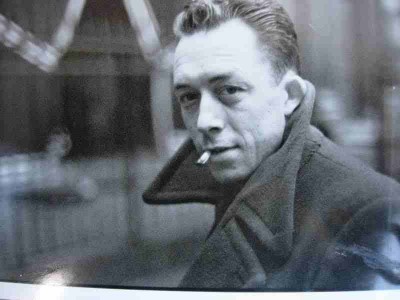
Author Quotes: Albert Camus’s Atheist Perspective On Christianity, Part II


“What the world expects of Christians is that Christians should speak out, loud and clear, and that they should voice their condemnation in such a way that never a doubt, never the slightest doubt, could rise in the heart of the simplest man. That they should get away from abstraction and confront the blood-stained face history has taken on today. The grouping we need is a grouping of men resolved to speak out clearly and to pay up personally. . .

———-

And now, what can Christians do for us?
To begin with, give up empty quarrels, the first of which is the quarrel about pessimism. . .

If Christianity is pessimistic as to man, it is optimistic as to human destiny. Well, I can say that, pessimistic as to human destiny, I am optimistic as to man. And not in the name of a humanism that always seemed to me to fall short, but in the name of an ignorance that tries to negate nothing.

This means that the words “pessimism” and “optimism” need to be clearly defined and that, until we can do so, we must pay attention to what unites us rather than to what separates us.

———–

We are faced with evil. And, as for me, I feel rather as Augustine did before becoming a Christian when he said: “I tried to find the source of evil and I got nowhere.” But it is also true that I, and a few others, know what must be done, if not to reduce evil, as least not to add to it. Perhaps we cannot prevent this world from being a world in which children are tortured. But we can reduce the number of tortures children. And if you don’t help us, who else in the world can help us do this?

. . .It may be, I am we’ll aware, that Christianity will answer negatively. Oh, not by your mouths, I am convinced. But it may be, and this is even more probable, that Christianity will insist on maintaining a compromise. . .Possibly it will insist on losing once and for all the virtue of revolt and indignation that belonged to it long ago. In that case Christians will live and Christianity will die.”

– Excerpts from Albert Camus The Unbeliever And Christians

__________

In Part I, Camus opened this lecture with his own gracious disclaimer on Christianity.

Camus gave this lecture in 1948, in the wake of WWII. As a humanist and also a passionately moral man, his calls to action were built upon wreckage of the war and the seeming ambivalence of the church at large to the world’s suffering. He calls to question whether a Christian should be so preoccupied with the eternal question that he disregards fighting for goodness here on earth. His discerning insights into the proper out-workings of this faith and his willingness to take on the same harsh implications of the role of outspoken defender of the weak are something powerful to behold.
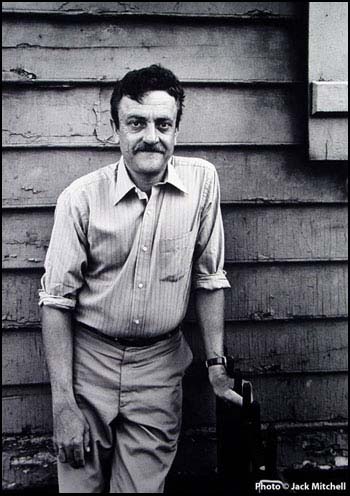
55 Classics Review #8 – Slaughterhouse-Five by Kurt Vonnegut


Slaughterhouse-Five is turmoil turned ’round on itself, ad infinitum. So it goes.

Before I started reading Slaughterhouse I knew that I liked Vonnegut. I listened to Welcome To The Monkey House on audio book a few years ago and I found his speculative fiction fascinating and his writing style thoroughly comforting. Vonnegut is equally enjoyable read as he was read aloud.

Slaughterhouse-Five is a book of war. It tells you from the beginning that it has always been, even years before Vonnegut knew how to write it, a story of the Dresden fire-bombing of WWII. This bombing was the single most horrifying assault of the Second World War, targetting civilian populations and killing about twice as many as the atom bomb did in Hiroshima. The entire city of Dresden was razed to the ground and even after his widely acclaimed book it is little remembered. Vonnegut was a POW in Dresden at the time and one of a very small number of survivors. Like many war veterans, Vonnegut didn’t know how to deal with what he has experienced, but as a writer he couldn’t let something so definitive to his worldview be left untouched. Thus, Slaughterhouse-Five.

The book feels like a mad rambling. It begins and ends with a lot of Vonnegut personally talkings about how and why he is writing this book so many years later, and it doesn’t always make complete sense. When he finally gets along to the story he means to tell, it is also disjointed. It makes sense that it is disjointed, because his world is ultimately disjointed.

Even though I was familiar with some of his science fiction, I was completely caught off guard to find it here. The book follows Billy Pilgrim, Dresden POW, alien zoo experiment, and man disloged from time. Feeling like a series of end-of-life flashbacks, we are actually supposed to be traveling through time over and over, re-experiencing aspects of Pilgrim’s life at all its various stages. As a man who no longer thinks about his history linearly, Pilgrim has found infinite peace in being able to detatch himself from being effected by the horrors around him.

Vonnegut’s goal is not simply to tell horror stories of war. He excercises great restraint in sharing the details of Dresden. A considerably small percentage of the text actually covers the war. Much of it is spent in subsequent life and on an alien planet. It would be easy to interpret Pilgrim’s later alien adventures and time-traveling as Vonnegut’s attempt to point out how the insanity of war drives men to a truer insanity, but I think we lose something in explaining the book under strictly realistic experiences. We are meant to believe in Pilgrim’s aliens and travels. They mean something if they are real which they do not if they are hallucinations.

You can easily see that Vonnegut associated organized religion very closely with politicking and war-making. He uses the aliens and time traveling as an opportunity to predicts a philosophical loophole. Religions of the world can be damned, but there is probably something else out there, some better way to live and view our existing that puts all of human history in a catagory of foolishness beyond comprehension. Vonnegut is sold on the idea that this ideal exists, but he doesn’t write hoping of it. Pilgrim proclaims it but humanity is incapable of joining in his new bliss.

I think that the juxtaposition of Vonnegut’s style against his attitudes adds a huge element of what draws people to his work. He writes straightforward and comical persons and scenes. When he describes a man, we invision a dopy, cartoon character that feels foolishly and warmly human. Then this character commits historically-accurate crimes against humanity. Or he stands by and becomes numb to his hurts, is mocked as a fool for being totally shaken, and lives on to inflict lesser hurts on his home in its future peace. Vonnegut warms us up and then gently affirms that existence is a train of horrors at the hands of humanity.

I think that Slaughterhouse-Five is valuable, important even. It displays just how enjoyable a book can been even in describing utter evil, which is a confusing and concerning reality. It points to every man as an open book with a broken spine. There is no good or bad man, there is only mankind, and it is gross and predicatable.

The books thesis, repeated over and over when referring flippantly to death and distruction, is, simply, “So It Goes.”

Author Quotes: John Updike and The Necessity Of The Uber-Miracle


Make no mistake: if He rose at all
it was as His body;
if the cells’ dissolution did not reverse, the molecules
reknit, the amino acids rekindle,
the Church will fall.

It was not as the flowers,
each soft Spring recurrent;
it was not as His Spirit in the mouths and fuddled
eyes of the eleven apostles;
it was as His flesh: ours.

The same hinged thumbs and toes,
the same valved heart
that–pierced–died, withered, paused, and then
regathered out of enduring Might
new strength to enclose.

Let us not mock God with metaphor,
analogy, sidestepping, transcendence;
making of the event a parable, a sign painted in the
faded credulity of earlier ages:
let us walk through the door.

The stone is rolled back, not papier-mâché,
not a stone in a story,
but the vast rock of materiality that in the slow
grinding of time will eclipse for each of us
the wide light of day.

And if we will have an angel at the tomb,
make it a real angel,
weighty with Max Planck’s quanta, vivid with hair,
opaque in the dawn light, robed in real linen
spun on a definite loom.

Let us not seek to make it less monstrous,
for our own convenience, our own sense of beauty,
lest, awakened in one unthinkable hour, we are
embarrassed by the miracle,
and crushed by remonstrance.

SEVEN STANZAS AT EASTER

John Updike, 1960.
________

I have been reading a lot about John Updike lately, both his Pulitzer-prize winning fiction and his philosophical essays and memoirs. He seems a man with uniquely developed perspectives and he’s climbing quickly to the top of my “Need To Read” list. In my earliest endeavors to learn about the man I stumbled upon this poem, at just the right moment.

55 Classics Review #7 – The Giver by Lois Lowry


I expected to enjoy The Giver more than I did. Then I enjoy it more than I suspected I had.

Almost everyone else read this book in like 5th grade. I missed it. My impression has long been that most people hold a relatively positive memory of the book, so I have been looking forward to it for some time. All I really knew is that it was set in some type of dystopia; I always get excited to start a classic title whose plot is relatively unknown to me.

Although I wasn’t too discouraged, I was immediately put off by the writing style Lowry employs. I tend to have trouble reading dystopian stories because of their sterility and Lowry’s style felt more sterile than her fiction environments. It was easy and interesting reading though, so I had little trouble continuing. She really does a good job of keeping you guessing on a lot of the details of the future world she creates and of making you begin to wonder whether the characters will ever even grow discontent with the world they have been given. I caught myself nervously wondering if perhaps she was actually promoting this world when I reached the halfway point in the text and still no one was revolted by the strictly-governed world at hand. Then, in the blink of an eye, the book became a roller coaster of emotions, rebellion, and deep, impactful character decisions.

Eventually, I realized that Lowry had tricked me with her disturbingly sterile writing style. I expected her characters to revolt immediately. She made me understand them in their original state for so long that I was afraid I would be asked to approve of their world. She also forced me to approach the very old questions of death, war, beauty, art, and human relationships from an altogether new direction. I think about these issues constantly, yet I found myself looking at them from a different vantage point. I asked myself “If art and war require one another, would it be better to forgo both or accept both?”

Without giving away the plot, I will say that the end of the book is both jarringly abrupt and quite open to interpretation. I turned the page expecting the text to continue and read THE END. Then I flipped back again. Then I wet my fingers and tried to separate the pages. No, that’s just the way it ends. And it’s actually a great and important way to end the book.

I thought I would enjoy The Giver as a thoughtful and youthful read, but it turned out to be a bit trickier. As I read on, frustrated at every turn, I looked back and realized that all the things I didn’t enjoy made immense sense in retrospect.

Although it’s hard to find another category for it, I would argue that The Giver is not a dystopian story in the classic sense. Most dystopias are strife-filled quasi-allegories meant to highlight the extreme errors available to humanity if there is not a healthy political and technological balance. The Giver makes its new, relation-less world look, well, okay. Once we can begrudgingly agree to this, it asks us if okay is something we can settle for.

Then we wrestle.

Author Quotes: Albert Camus’s Atheist Perspective On Christianity, Part I


“Inasmuch as you have been so kind as to invite a man who does not share your convictions to come and answer the very general question that you are raising in these conversations, before telling you what I think unbelievers expect of Christians, I should like first to acknowledge your intellectual generosity by stating a few principles.

First, there is a lay pharisaism in which I shall strive not to indulge. To me a lay pharisee is the person who pretends to believe that Christianity is an easy thing and asks of the Christian, on the basis of an external view of Christianity, more than he asks of himself. I believe indeed that the Christian has many obligations but that it is not up to the man who rejects them himself to recall their existence to anyone who has already accepted them. . .

Secondly, I wish to declare also that, not feeling that I possess any absolute truth or any message, I shall never start from the supposition that Christian truth is illusory, but merely from the fact that I could not accept it. . .

Having said that, it will be easier or me to state my third and last principle. It is simple and obvious. I shall not try to change anything that I think or anything that you think (insofar as I can judge of it) in order to reach a reconciliation that would be agreeable to all. On the contrary, what I feel like telling you today is that the world needs real dialogue, that falsehood is just as much the opposite of dialogue as is silence, and that the only possible dialogue is the kind between people who remain what they are and speak their minds. This is tantamount to saying that the world of today needs Christians who remain Christians. The other day at the Sorbonne, speaking to a Marxist lecturer, a Catholic priest said in public that he too was anticlerical. Well, I don’t like priests who are anticlerical any more than philosophies that are ashamed of themselves. Hence I shall not, as far as I am concerned, try to pass myself off as a Christian in your presence. I share with you the same revulsion from evil. But I do not share your hope, and I continue to struggle against this universe in which children suffer and die.”

– Albert Camus, from his 1948 essay, The Unbeliever and Christians
___________

Although he tended to shy away from the categorizations, Noble-prize winning author Albert Camus is known as an important figure of both Absurdist and existential schools of philosophy. He was also an atheist who knew how to speak respectfully to those with whom he had fundamental disagreements. Here we have him not only spelling out the ideals that led him to this perspective but also putting them into play. The above mentioned essay was originally the introductory statements of a lecture he gave at the Dominican Monastery of Latour-Maubourg.

I use social media and I live in America. Every day I see articles and endless comment threads spewing violently anti-dialogue hatred. As of recently I have also had the personal pleasure of entering into a couple of lengthy, social media based conversations with those of drastically opposing world-views. It brings me immense joy to be able still to find and honestly give the title of “friend” to those opposite who are interested in expressing themselves without contempt for their fellow human beings. We need more authentic dialoguers.

I approach the body materials of Camus’s The Unbeliever And Christians in Part II.

55 Classics Review #6 – On Stories And Other Essays On Literature by C.S. Lewis


When it comes to popular spiritual epigrams, C. S. Lewis has G.K. Chesterton, Martin Luther King, Ghandi, and maybe Jesus himself beat in terms of popular quotability. It seems impossible to browse any social media outlet without coming across a line from Narnia or The Screwtape Letters. That is what intrigues me the most about Lewis. A huge quanitity of the most enlightening statements he ever made came from the mouths of characters in fiction, rather than from any articles of non-fiction.

On Stories is therefore one of the greatest resources for getting behind this veil. In it we discover bits of the frame of mind capable of creating such original and timeless stories that seamlessly imply his deepest ideas about being human.

The book is a simple collection of essays, author dedications, op-ed pieces, and even a transcript of a conversation between Lewis, Kingsley Amis, and Brian Aldiss about the nature and value of science fiction as a genre. Many of the articles were never published, some merely scraps, unedited and unfinished.

On Stories cover a lot of ground, seeing Lewis address concepts and wrestle with idea which many of his popular quoters might find questionable or reproachable. He expresses interest in seeing good science fiction proposing a third gender, proposed that children’s literature shouldn’t shy away from being frightening, and emphatically endorses a lot of literature which some people might prefer to be banned. Overall, you are getting a much more rounded picture of the author’s ideas than you ever can from any piece or body of fiction.

The themes that come through most clearly are his strong opinions about fantasy and science fiction being absolutely valuable endeavors for both children and adults and his general rebuttals against the overwhelming academic ideas on literature from his day. He proves himself extremely well-read in everything from the classics (no surprise here as he was a world-class medievalist) to the science fiction paperbacks which were just gaining a huge foothold. He holds firmly that each has its own place of legitimate value to the reader.

One of my personal favorites was A Reply To Professor Haldane. A posthumously discovered response to the multiple, brutal assaults on his intellect by a professor of theoretical biology, this essay is at once precisely factual and sterile of any character assassinations. A discovered rough draft like this only highlights the immensity of logical preparation he puts into his ideas. He explains himself theoretically and through example while completely tearing down his opponent’s ideas without ridiculing the man. Indeed, it is easy to feel that Lewis has no emotional response to those who continually abused his character. Like Chesterton, one cannot help but admire his ability to let accusations roll off his back while taking the ideas involved quite seriously.

Overall, I highly suggest this title to any Lewis fan or general fan of science fiction and fantasy. If you’ve ever felt frustrated at those who don’t get why fairy tales or space travel stories are legitimate, you will find a friend in Lewis. I would also highly recommend this book if you’re interested in reading the more obscure works that have influenced modern fantasy, adventure, and sci-fi writing. Lewis is constantly referring to what he considered the classics of these genres.

Though you may not always agree with his conclusions on the issues he tackles, it is hard to fault the man for lack of thorough contemplation or sincerity in wrestling with all forms of literature.

_____________

I’ll leave you with this delightful transcribed dialogue between Lewis and Kingsley Amis, and Brian Aldiss.


“Lewis: Would you describe Abbott’s Flatland as science-fiction? There’s so little effort to bring it into any sensuous–well, you couldn’t do it, and it remains an intellectual theorem. Are you looking for an ashtray? Use the carpet.

Amis: I was looking for the Scotch, actually.

Lewis: Oh, yes, do, I beg your pardon. . .But probably the great work in science-fiction is still to come. Futile books about the next world came before Dante, Fanny Burney came before Jane Austen, Marlowe came before Shakespeare.

Amis: We’re getting the prolegomena.

Lewis: If only the modern highbrow critics could be induced to take it seriously. . .

Amis: Do you think they ever can?

Lewis: No, the whole present dynasty has got to die and rot before anything can be done at all.

Aldiss: Splendid!

Amis: What’s holding them up, do you think?

Lewis: Matthew Arnold made the horrible prophecy that literature would increasingly replace religion. It has, and it’s taken on all the features of bitter persecution, great intolerance, and traffic in relics.”


Related Reading

————

C.S. Lewis and Common Core Logic

C.S. Lewis On How Words Die

C.S. Lewis and J.R.R. Tolkien On Our Connection To The Land

Author Quotes: Wendell Berry On Paths And Roads


“The difference between a path and a road is not only the obvious one. A path is little more than a habit that comes with knowledge of a place. It is a sort of ritual of familiarity. As a form, it is a form of contact with a known landscape. It is not destructive. It is the perfect adaptation, through experience and familiarity, of movement to place; it obeys the natural contours; such obstacles as it meets it goes around. A road, on the other hand, even the most primitive road, embodies a resistance against the landscape. Its reason is not simply the necessity for movement, but haste. Its wish is to avoid contact with the landscape; it seeks so far as possible to go over the country, rather than through it; its aspiration, as we see clearly in the example of our modern freeways, is to be a bridge; its tendency is to translate place into space in order to traverse it with the least effort. It is destructive, seeking to remove or destroy all obstacles in its way. The primitive road advanced by the destruction of the forest; modern roads advance by the destruction of topography.

That first road from the site of New Castle to the mouth of the Kentucky River–lost now by obsolescence or metamorphosis–is now being crossed and to some extent replaced by its modern decendant known as I-71, and I have no wish to disturb the question of whether or not this road was needed. I only want to observe that it bears no relation whatever to the country it passes through. It is a pure abstraction, built to serve the two abstractions that are the poles of our national life: commerce and expensive pleasure. It was built, not according to the lay of the land, but according to a blueprint. Such homes and farmland and woodlands as happened to be in its way are now buried under it. A part of a hill near here that would have caused it to turn aside was simply cut down and disposed of as thoughtlessly as the pioneer road builders would have disposed of a tree. It’s form is the form of speed, dissatisfaction, and anxiety. It represents the ultimate in engineering sophistication, but the crudest possible valuation of life in this world. It is as adequate a symbol of our relation to our country now as that first road was of our relation to it in 1797.”

– Wendell Berry, excerpt from A Native Hill
____________

Berry’s words are potent, but they carry an extra weight for those have grown up on I-71 and can visualize its toll on the land. It’s true that the principle remains the same anywhere, but part of his point lies in relating to the land itself, and I can picture the very landscapes he has in mind.

A Native Hill is a wonderful and expansive essay covering Berry’s own flight from and eventual enlightened return to the Kentucky hillside his forefathers had long farmed.

55 Classics Review #5 – Frankenstein by Mary Wollstonecraft Shelley


As I was finishing Frankenstein I happened upon the cover of a children’s science magazine that said, “Should we bring extinct species back to life?” It is troubling to me that the imaginary science of Frankenstein is so dangerously close to what we find modern science capable of today and the moral obligations are still as foreign to those who practice now as they were to Frankenstein himself.

There was so much I loved and some I hated in these pages, but before I get into what I have to say I must state that there is probably no work of fiction more greatly abused by film adaptations than Frankenstein.

There is no groaning ghoul, there are no pitchfork-welding villagers, there is no accidental murder, and no animalistic fear of fire. The film adaptations of this story are literally their own works of fiction entirely. Mel Brooks’ film Young Frankenstein is about as close to the text as any other film I’ve yet happened upon.

This actually made Frankenstein a delightful read. The sheer foreignness of the story kept me on the edge of my seat. The original text is surprisingly readable even though it was published in 1818 and it reminded me a lot of the writing style Bram Stoker put into Dracula nearly a century later. Shelley employs a series of letters and story-within-story retelling to add depth and believability to her tale. While the characters can become a little wordy in their impassioned monologues, I was ultimately very pleased with the writing style.

The great thing that I never knew about Frankenstein is the complexity of implied and directly addressed questions of the brokenness and disconnections of humanity. Both Frankenstein and his creation are constantly reflecting on their own powers for good, enjoyment of natural beauty, and horrifying capabilities toward evils.

The story is told through the interactions of a fearless young explorer who encounters Frankenstein, and it would be easy to take the story as a treatise against morally questionable science practices if the main characters weren’t constantly oscillating between cursing Frankenstein’s blind science power trip and priding themselves in their own capabilities as fearless leaders. Frankenstein, his monster, and the narrator quickly fall back and forth between horror at the careless evil he committed and confidence in the powers of men to overcome the world.

Here we come to the part I didn’t like about the story. From a purely narrative perspective, I have always been easily annoyed by characters who see miscommunication happening and do nothing to rectify it. Perhaps I’m a bit of an over communicator, but I hate stories where nothing is done to clear up simple and tragic misunderstands. Frankenstein himself spends the majority of his life after the creation of the monster watching in silent horror as the repercussions of his creation play out, doing nothing or far too little too late. He refuses to confess his action to all those closest to him, despite the increasing toll it takes. The only time he decides to take any really decisive action is when he desires to kill the monster. The monster is similar, originally eager to see beauty, family, and community. When he can’t get these, he rages and eagerly pursues the greatest opposing horrors.

This aspect of the story does not ruin the story by any means, but it does provide a defeatist tone. It is full of terror, but maybe the greatest tragedy is how little any character is actually willing to pursue the good, beauty, and truth which they so eagerly live for, but each is more than happy to act on every violent impulse which provokes them.

As I read the story I began to feel strongly that Frankenstein is a grandfather text to both surrealist and science fiction genres. The story is classic science fiction and the character’s monologues feel like a precursory stepping stone to what Kafka would write a century later.

The book does a wonderful job of exploring the philosophical questions surrounding moral obligations in science, what it is to be human, the beauty and evils of mankind, and the terror of total ostracism from relationship. The violent and self-destructive tone does not destroy the power of the story, but it does leave us without a real protagonist, with ultimately confused and powerfully nihilistic characters.

Wanna Change The World? Shake Someone’s Hand!


We see it almost every day. Whether its a government cover-up, corporate fraud, or a religious group’s controversial public statements, we are bombarded more than every by a constant stream of articles and headlines about the latest controversies. Thanks to social media, we are becoming the ones who are most responsible for determining what issues gain steam and become headlines. I’m just as guilty as anyone else of feeling required to chime in and make sure other people hear my opinions on the current big issue. We find it necessary to identify ourselves as being for or against these brands.

Brands, you may ask? Why yes, every political candidate, Hollywood star, and non-profit organization is, at its core, simply a brand. Nowhere is this more apparent than in the social media world of likes, retweets, and reposting sensationalized articles. We recognize and either endorse or condemn nearly every public entity as a brand to be consumed or blacklisted in our modern online context.

But what most of us really want is to make the world a better place, right? I mean, isn’t that what we think we want somewhere deep down? Isn’t that in some dysfunctional way connected to the root motivation of many of our pins and tweets and likes and posts? How can we begin to actually make this world a better place to live? By liking statuses and reposting inspirational memes?

Here’s the fact:  We are hiding behind our ideas of good and bad when we should be acting upon them. We’re trying to decide what to endorse when we should be asking ourselves how to take action and relate.

Relate? Yes, as in a relationship, where two beings enter into actually knowing one another personally and, often, in person. True, this does require more work than scrolling through a newsfeed and often it will entail sharing our own hopes, dreams, mistakes, and brokenness, but I will promise you something. If you do this often, it will prove to be worth your time.

What if we stopped investing so much of our time into reading articles about group’s stances and started reaching out to tell our friends what encourages us about them? What if we stopped trying to decide where to point the finger and started lifting one to help a new neighbor move in? Supporting a non-profit that helps the hungry in the third world is really important and hugely valuable, but helping the homeless in your own city has a greater impact on you and builds an actual, ongoing relationship between you and the people your helping.

So get out there! Be a great dad. Be a great mom. Be a great dad or mom to someone even if you have no children of your own. Make meals for people you don’t know well. It’s okay that it might be awkward the first time. Share a beer on your porch with the guy next door after work. Write a letter, on paper, and mail it to someone you highly value. Start investing into the real people all around you.

You might just find that pointing out the bad has never been as rewarding as doing the good.

_______________

Related:

– On the dangers of being Optimistic

– Poetry and Children and War

– How does the Common Core Standard hold up?

Listen Awhile Ye Nations, And Be Dumb.


Great spirits now on earth are sojourning;
He of the cloud, the cataract, the lake,
Who on Helvellyn’s summit, wife awake,
Catches his freshness from Archangel’s wing:
He of the rose, the violet, the spring,
The social smile, the chain for Freedom’s sake:
And lo!–whose steadfastness would never take
A meaner sound than Raphael’s whispering.
And other spirits there are standing apart
Upon the forehead of the age to come;
These, these will give the world another heart,
And other pulses. Hear ye not the hum
Of mighty workings?–
Listen awhile ye nations, and be dumb.
________

– John Keats, Addressed To Haydon, 1816

I never got poetry. When I was in elementary school my younger brother and I collected a binder full of our own attempts at poetry, but the only goal was to write simple, silly verses that rhymed. Apart from thoroughly enjoying complex rhymes, I never understood the draw of poetry. Even in school I never understood the enjoyment of poetry and the basic concepts involved didn’t make me excited. I couldn’t force iambic pentameter to mean anything on paper and I was without a passionate poet, so it bored me thoroughly. I was never really sure what to make of free verse.

Now, a decade later, I’m starting to really think there might be something I missed in this poetry stuff. I mean, I always assumed it must truly interest many people, but I wasn’t one of them. After realizing that so many people I respect were either heavily fashioned by poetry or were poets themselves, I have become somewhat determined to invest myself in understanding its enjoyment.

The three things I’ve come to understand about poetry thus far are that it is best read slowly, aloud, and indulgently.

Perhaps what I mean is that, in my experience, poetry is only enjoyable when it is paired with a slow lifestyle. When I was a child I assumed it was simply about rhyming. In school I never understood how the more complicated terminology explained any enjoyment. Now I am starting to realize that the poetry itself lies in the audible flow of the words.

I’ve always greatly appreciated prose. A witty or profound sentence full of large or interesting words is sure to be a delight. Now I’m starting to realize that poetry carries a similar intoxicant which is meant for sipping. Poetry is for re-reading, for memorization even, both skills that seems to have mostly fallen out of vogue. Memorization for pleasure rather than duty.

I have started slowly with the mostly free verse of Wendell Berry. His wonderful prose requires slow reading, and the transition to his poetry is a smooth one. From there I have begun to dabble in Keats, and I hope to eventually build up an appetite for modern poetry like Elliot and the old epic poems like La Morte D’Arthur, Spenser, and Milton.

My goal in this busy world is to slow down, so I think poetry is all the more worthy a pursuit. Like Keats says, if we slow down enough to take it all in, perhaps we will be able to stay quiet for a bit.

If you love poetry, please tell me why, and by whom.